
Industrial Sensing & PHM
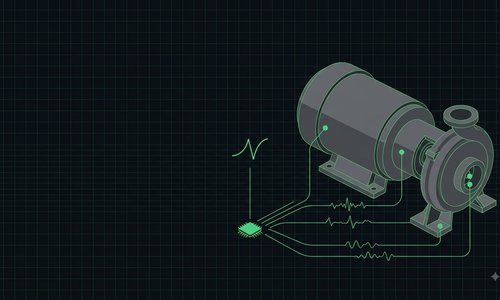
Near-sensor processing of vibration, acoustic, temperature, and electrical signals for prognostics and health management — machines that report their own condition.
- Always-on anomaly detection at the sensor, inside a milliwatt power budget
- Events and health indices leave the machine, not raw high-rate waveforms
- Prognostics: estimate remaining useful life, not just detect the fault after it happens

What we keep being asked
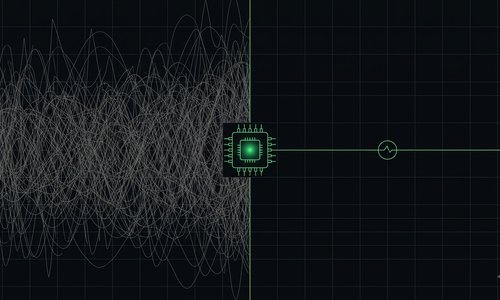
Operations leaders want machines that predict their own failures. The obstacle is data volume: vibration streams are far too heavy to ship anywhere, so the analysis has to happen where the signal is measured.
What it is
Rotating and powered equipment emits its condition continuously: vibration spectra, acoustic signatures, motor current, temperature. Prognostics and health management turns those streams into a health index, fault alarms, and remaining-useful-life estimates. The data problem is locality — a single vibration channel at tens of kHz is too much to stream, so the feature extraction and the anomaly model belong at the sensor. That is the same “transmit results, not raw data” architecture we already build for vision.
Why now
The predictive maintenance market is projected to grow from $13.9B in 2026 to $23.8B by 2031, an 11.4% CAGR[11], with PHM systems growing at a similar rate and sensors holding the largest share of the monitoring stack[12]. On the model side, time-series foundation models such as TimesFM and Chronos now give strong anomaly detection on standard bearing and plant datasets[13][14], and compact distilled versions of them are credible candidates for edge deployment.
What UXF brings
This extends our existing Bio and Sensor Domains capability from biology to the factory floor. We co-design the sensing chain — which signals, which features, which compact model, and what it costs in energy — with measured numbers on your own machines. It also connects to our domain-specific SLMs: a compact model can turn PHM outputs into maintenance reports in the operator’s language.
Early stage: pilot instrumentation studies
How we engage
First engagements are pilot instrumentation and co-design studies on a customer’s equipment: instrument a representative machine, establish a baseline, and report what the always-on detector costs in milliwatts. Request a briefing to scope a pilot.
Sources
- MarketsandMarkets, "Predictive Maintenance Market worth $23.79 billion by 2031".
- Verified Market Reports, "Prognostics Health Management System Market".
- Pebblous, "TimesFM Explained: Google's Time-Series Foundation Model for Predictive Maintenance (2026)".
- "ChronosAD: Leveraging Time Series Foundation Models for Accurate Anomaly Detection", arXiv:2606.01300.
Explore the rest of the stack
On-sensor AI Chip Solutions
AI processing directly at the sensor, enabling ultra-low cost and energy-efficient intelligence at the data source.
Learn more → Scalable-AIFlexible Multi-chip AI Solutions
Modular and scalable AI systems combining multiple chips, optimized for domain-specific performance and flexible deployment.
Learn more → AX-BiologyBio-AI Co-design Services
Integrated AI and hardware co-design for biological data analysis, accelerating discovery through multimodal data and lab automation.
Learn more → Language, specializedDomain-Specific Small Language Models
Compact language models tuned for one domain with supervised fine-tuning and grounded with retrieval — private translation and document intelligence that runs on-premise or on-device.
Learn more → AI that movesPhysical AI
Collaborative R&D with commercial robotics and humanoid teams in Korea and China — low-power perception for machines that sense and act in the real world.
Learn more →